Around this time I usually think about family and loved ones who have passed away. November 2 is Undas (All Saints’ Day), my favorite Filipino holiday. It’s a time for us to pause, gather at the cemetery, and honor our family and ancestors.
I’ve been trying to write this poem for a year; I was finally able to write it earlier this month although it’s still a work in progress. I hope it brings some comfort.
A translation

It’s been a year
since my uncle and aunt passed away,
two months apart.
One, unexpectedly.
The other, the inevitable release of air.

It’s been a year
since they died and I still
don’t understand why we say in English:
I’m sorry for your loss.
I’m sorry.

The same words we use to make excuses,
to admit fault or responsibility—
words spoken sometimes with sarcasm.

Ordinary, common words for something that isn’t ordinary at all.


My friend explains to me that in Korea
there is a specific phrase they use when the president dies.
A phrase only used in that instance.
A death considered so sacred and so precious
even the words bow down and pay their respects.

In Tagalog, we say:
Nakikiramay kami.
        A translation:
        We sympathize.

This is what I hear:
        Nakikiramay kami.
        We are with you.
        We are here, with you.
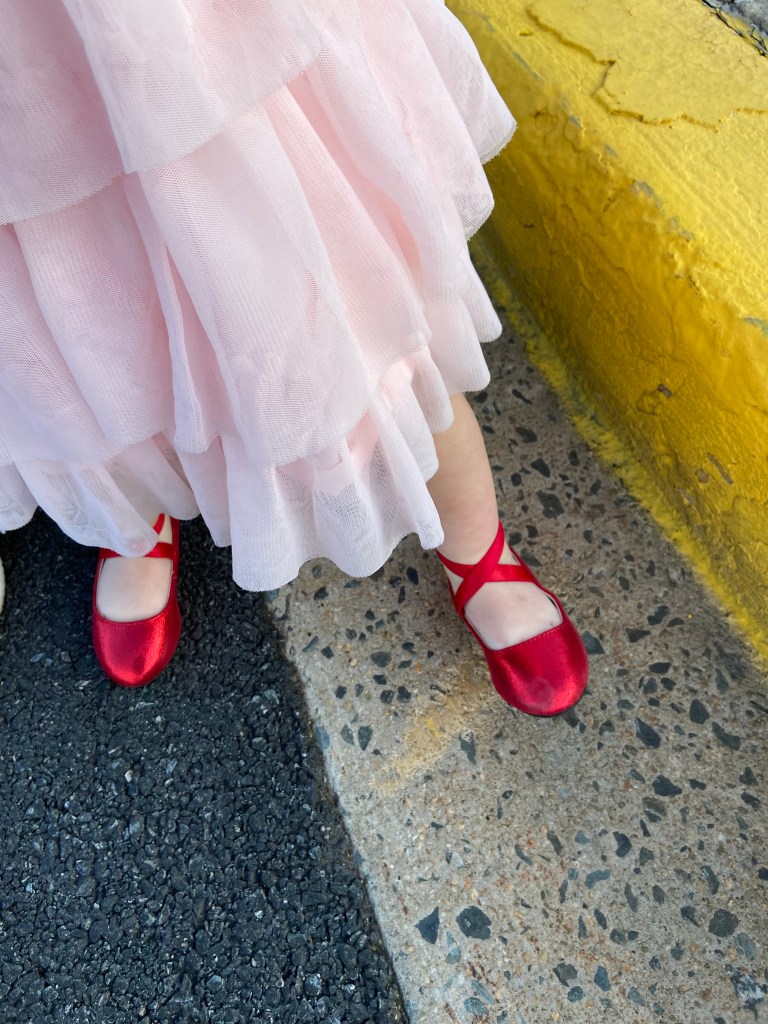
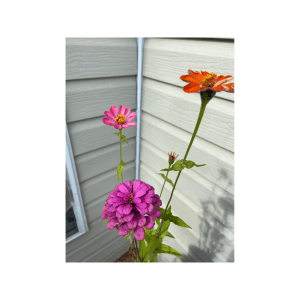
I recently finished reading Victoria Chang’s Dear Memory: Letters on Writing, Silence, and Grief and it inspired me to write in the epistolary style. This letter is inspired by the photo (below) I took recently of a family friend’s child.
Dear Sister,
The little girl turned two years old today. You should have seen her in her pink dress and ruby-red shoes. Her dress reminded me of the one our mother made for my 7th birthday. Do you remember that dress? The skirt with its layers of peach tulle.
The little girl ran around the parking lot, a flurry of pink and a flash of red. We tried to hold her back but she pulled us along until we resisted and planted our feet. You should have seen how she struggled to lead us to a destination of her choice, how badly she wanted to be free.
She is not mine but there are times now when she glances at me when she starts to play with another toy or makes a move toward the washi tape all neat and ordered in the acrylic box in my office. She looks up at me, her eyes searching, waiting to see if I will say something, or if I will rush over and stop her from touching things that aren’t hers.
She is only two and already I am trying to control her behavior, molding her to be obedient, to suppress her curiosity and playfulness. Is this what happened to me? To us?
I hear Lola in my voice every time I try to stop her movements. I don’t know if Lola would be proud or if she would find it funny that I of all her grandchildren turned out to be the most like her.
Do you remember how she would inspect the dishes after I washed them? This is why I waste so much water and soap, scrubbing more than once, brushing my fingers along every inch of the plate, checking for dried bits of rice I may have missed. Every time, it has to pass her inspection.
There was that moment when you must’ve been 11 or 12 and I was 8 or 9 when you accidentally dropped a tray of drinking glasses in the kitchen of our old apartment by the local high school. I don’t remember what Lola said to you; all I remember is Dad’s anger because she was more concerned about the broken glass than she was about you, centimeters away from bleeding.
We know now that doing something wrong does not mean there is anything wrong with us. Or do I? I look at that little girl’s eyes and I wonder if I ever looked like that (or still look like that), waiting for approval or disapproval, not knowing if one action will fill me with so much shame that I wouldn’t try it again. If all this time I haven’t let myself run and play without judgment like I used to out in the streets of Kawit, the town where I was born.
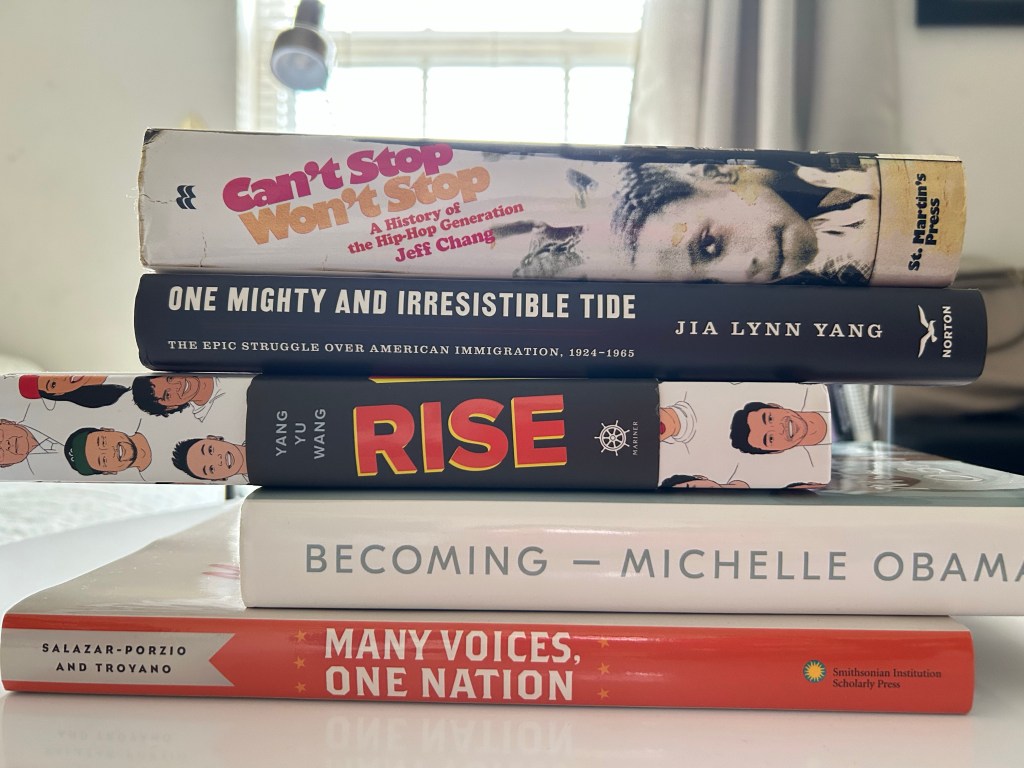
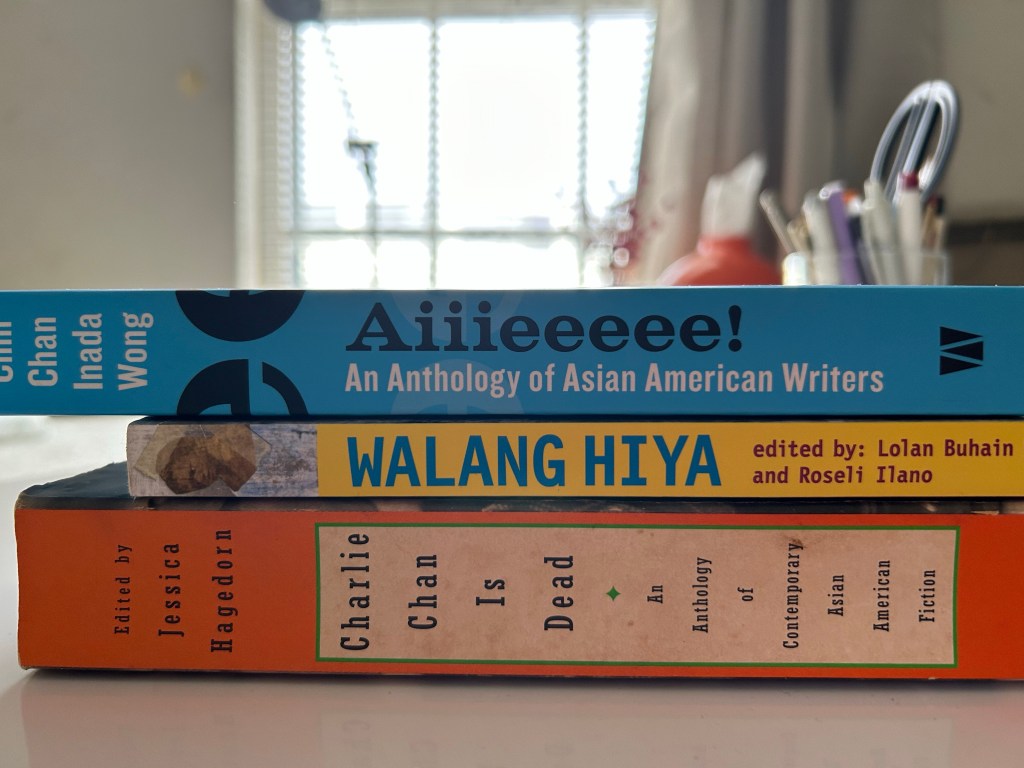
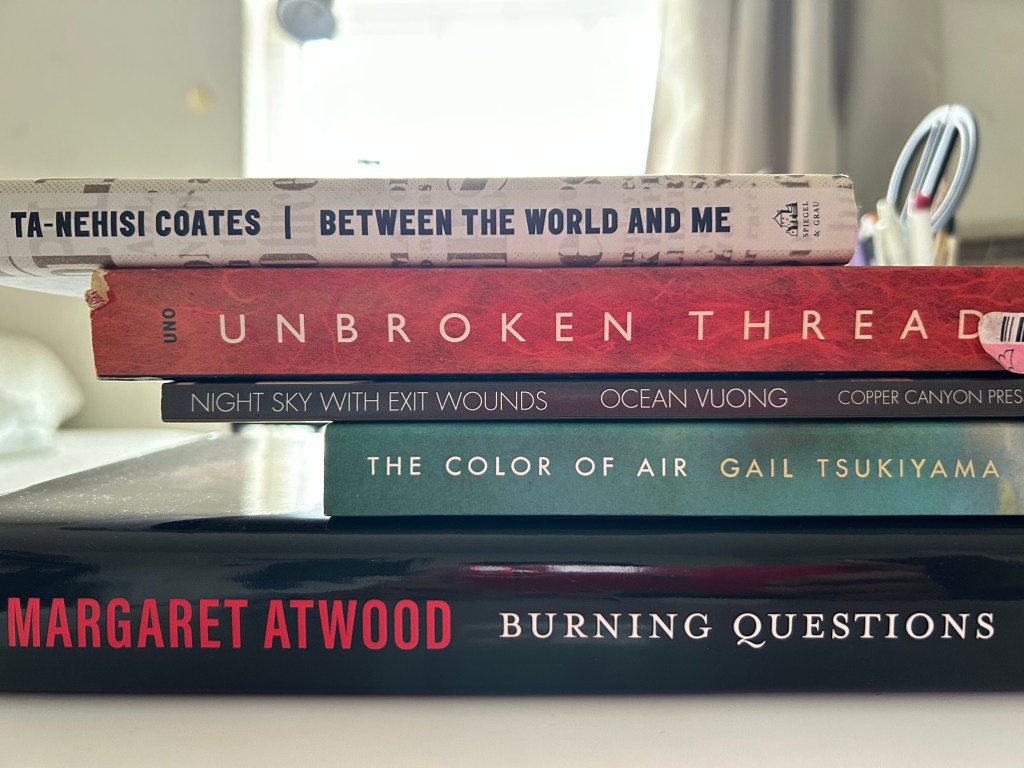
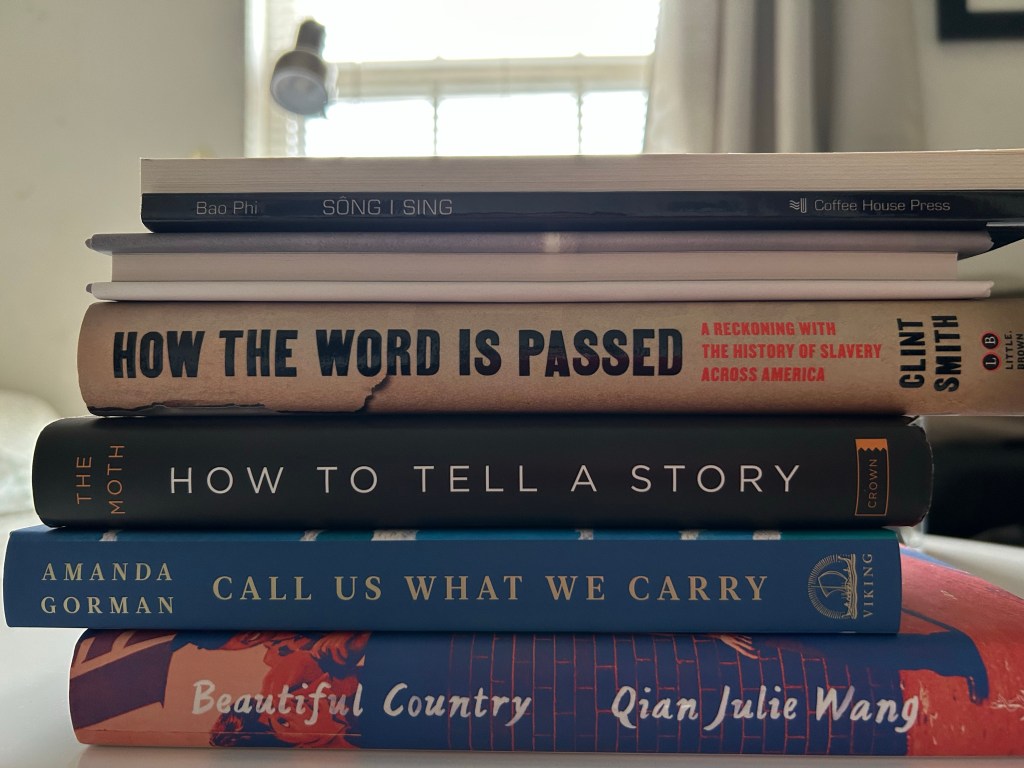
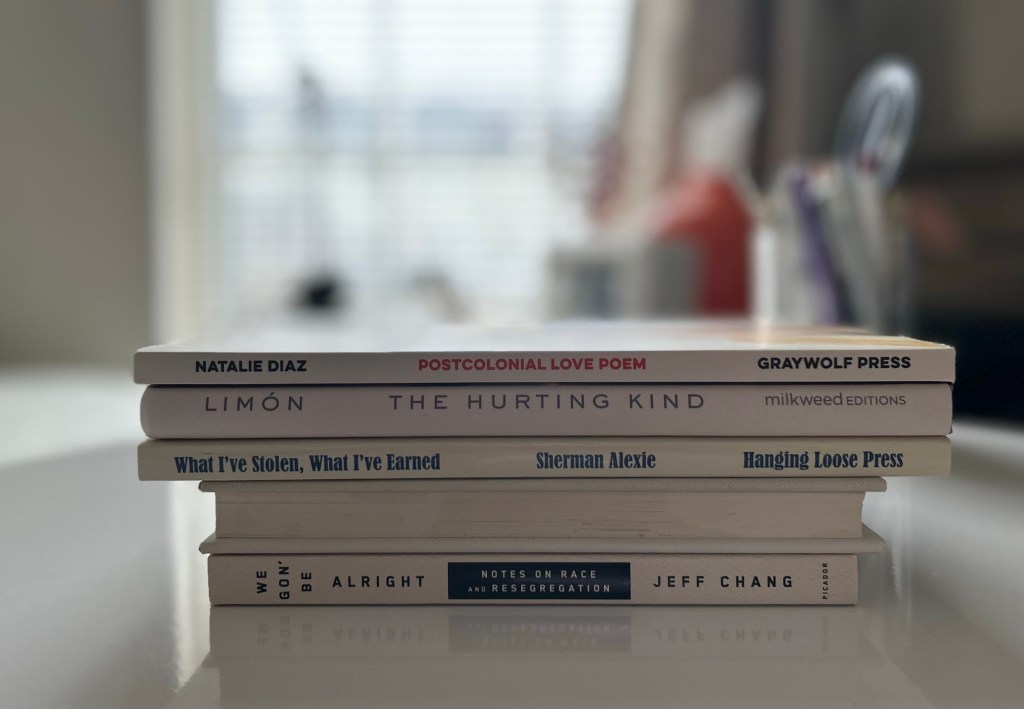
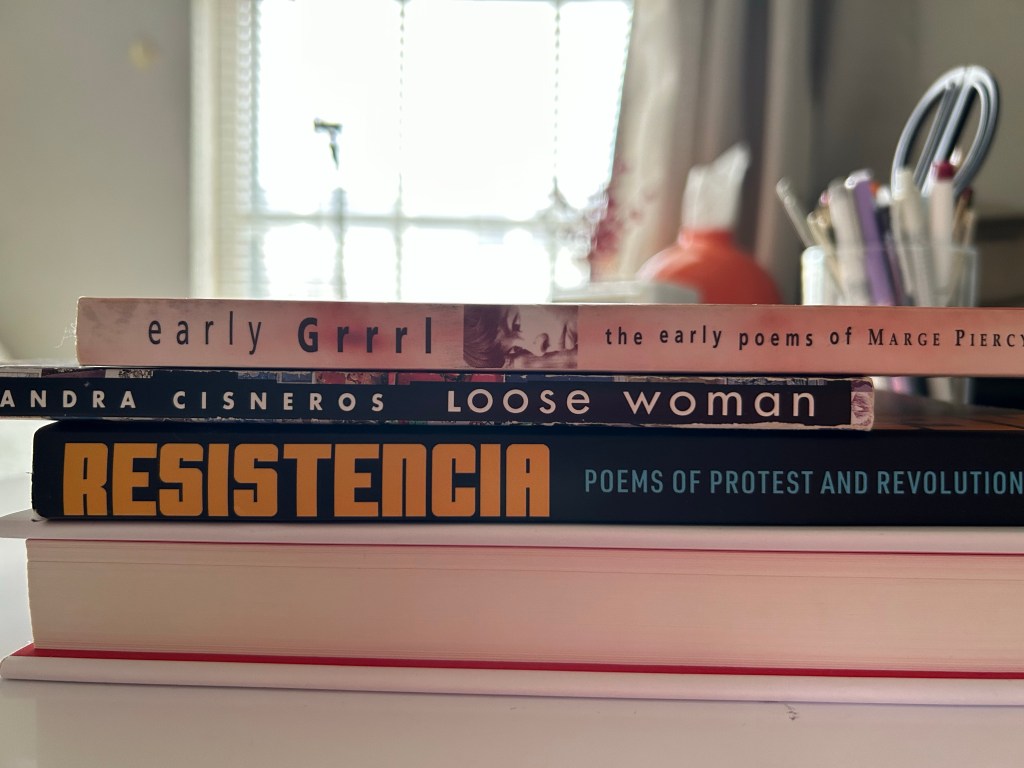
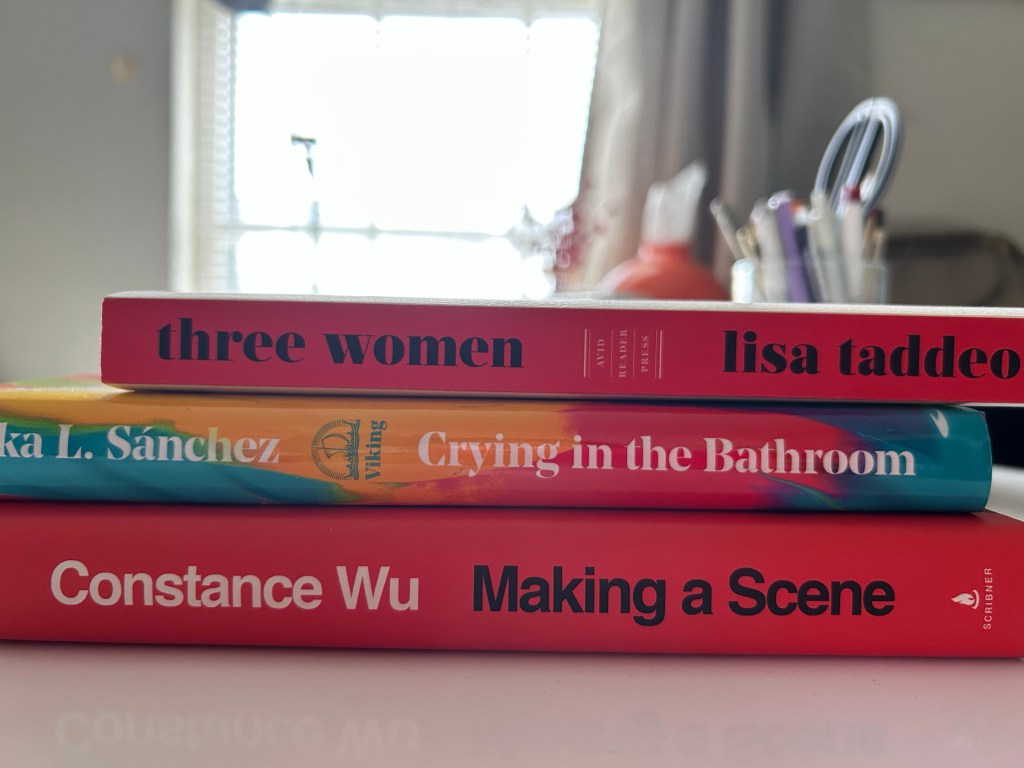
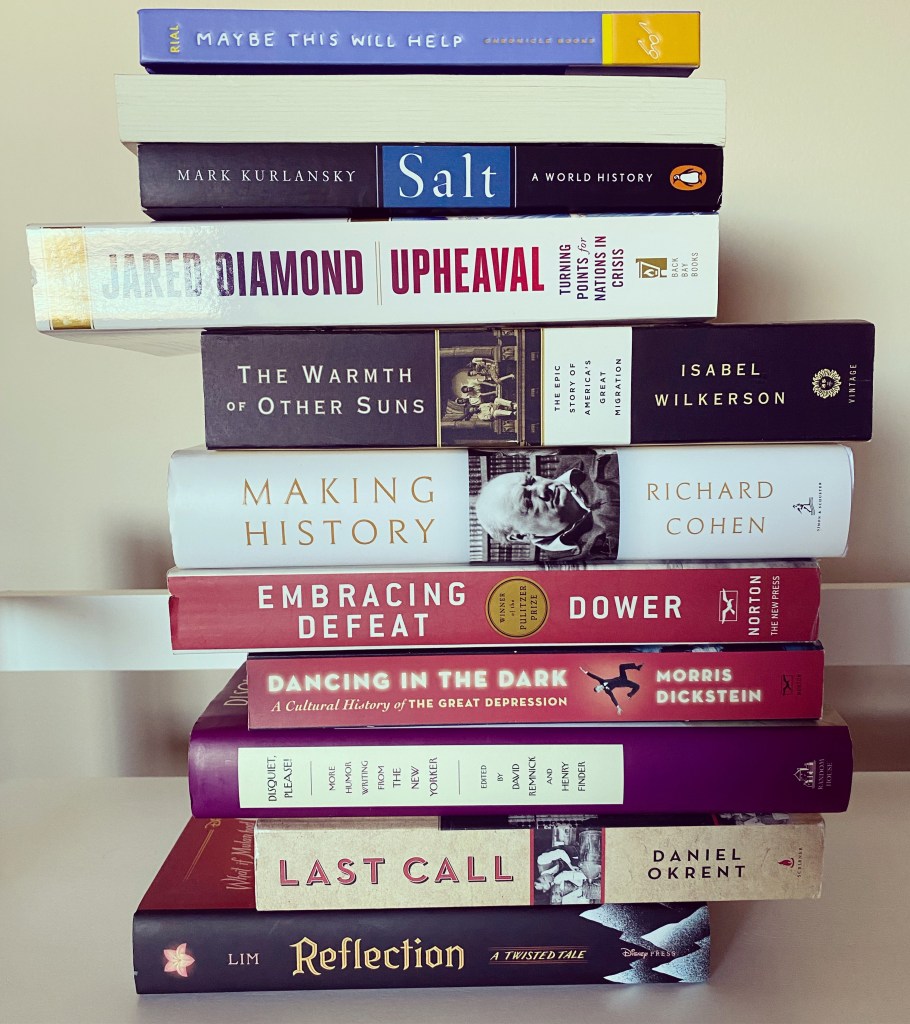
Only recently did I discover spine poems, a kind of verse “found” among book titles. I love found poems in general, as they often spur my creativity whenever I’m in a rut. When it’s hard to start with a blank page, sometimes you have to use what’s already out there and in the process create new meanings.
Below are my first attempts at creating spine poems from my collection of books. I think they’re quite good! If anything, it was fun to read book titles out loud, to listen to the rhythm of them, awaiting the moment the titles fall into place.
Can’t Stop Won’t Stop
One Mighty and Irresistible Tide
RISE
Becoming
Many Voices, One Nation
Aiiieeeee!
Walang Hiya
Charlie Chan Is Dead
Between the World and Me
Unbroken Thread
Night Sky With Exit Wounds
The Color of Air
Burning Questions
Song I Sing

How the Word is Passed
How to Tell a Story
Call Us What We Carry
Beautiful Country
Who We Be
After One Hundred Winters
Postcolonial Love Poem
The Hurting Kind
What I’ve Stolen, What I’ve Earned

We Gon’ Be Alright
Early Grrrl
Loose Woman
Resistencia
Three Women
Crying in the Bathroom
Making a Scene
And this last one is actually pulled from my sister’s bookshelves.
Maybe This Will Help

Salt
Upheaval
The Warmth of Other Suns
Making History
Embracing Defeat
Dancing in the Dark
Disquiet, Please!
Last Call
Reflection
After more than 26 hours of travel time and running on no sleep, I walked into the funeral home in Molino after midnight on a Friday morning. Mom immediately enveloped me in a deep hug. Dad had just fallen asleep on one of the pews having had little or no sleep for the past few days. When he saw me, he opened his eyes wide in acknowledgment, only to close them again in exhaustion.
Those first two days were filled with money exchanges, food orders, tasks delegated to family members from both sides, shopping trips, and coordinating who would stay at the funeral home. In the Philippines, when someone passes away, during the wake, or lamay, one must never leave the loved one alone. There must always be someone in the room, so family members and friends spend the night at the funeral home. Each room is equipped with a kitchenette and a full-size bathroom. Not wanting to get in the way of the process, I sat alone, scribbling in my notebook, trying to write a eulogy worthy of my aunt. When more people began to arrive for the last day of the lamay, I tried to speak with family members I met for the first time or no longer recognized or remember. A few referred to me as “Ye-Ye,” the childhood nickname I gave myself. A few commented on my inability to speak Tagalog. To my own surprise, I let the comment go, but it would torment me later. (It is unfair and inappropriate to call me an Englisero when I left the Philippines as a child and have lived most of my life in the US.)
Those first two days felt melancholy but not suffocating. (It would hit me later, usually when I am alone driving or in the early morning hours when I should be sleeping.) We were sad that Tita was gone, but we were also relieved that she was finally free again, no longer trapped in a body that had begun to deteriorate years ago. We even played a few rounds of Bingo to pass the time. The winners of the prize I offered—anything they want I’ll send in a balikbayan box—seemed blessed by my aunt, as if she was crowning them with her gratitude.
It wasn’t until the day after the funeral, on Sunday morning, that it felt like we could finally breathe collectively. I was only present for the tail end of a week-long lamay and an even longer waiting and visiting period when my aunt was in the hospital, but even I could sense the gloomy cloud lift just a little.
As a “thank you” trip, we went to Sky Ranch, a small amusement park in Tagaytay. We squeezed 16 people into a van, not including the driver. There were 21 of us in our group: my parents, me, members of both sides of my family, and a few family friends. Many of them were the ones who carried the burden of waiting, caring, traveling, coordinating, welcoming, cleaning.
It would strike me later how my parents were at the core of this gathering, now one of the few elders left of the Lares family tree. And me as the bridge between two family trees: Lares and Carvajal. For a few hours, I felt like part of one giant family, a contrast to how we grew up in America. When they say that an immigrant leaves behind a life, this is what I left behind: growing up and living with cousins, nieces, nephews, aunts, and uncles. The first few decades of living in the US were lonely. We may have been surrounded by a community of Filipino Americans in Maryland, but most of the relationships I formed then don’t go deeper than the occasional greeting at a party now or the news of life events such as engagements and births. We’re not bound to each other by DNA or shared experiences or money or legacy or expectations.
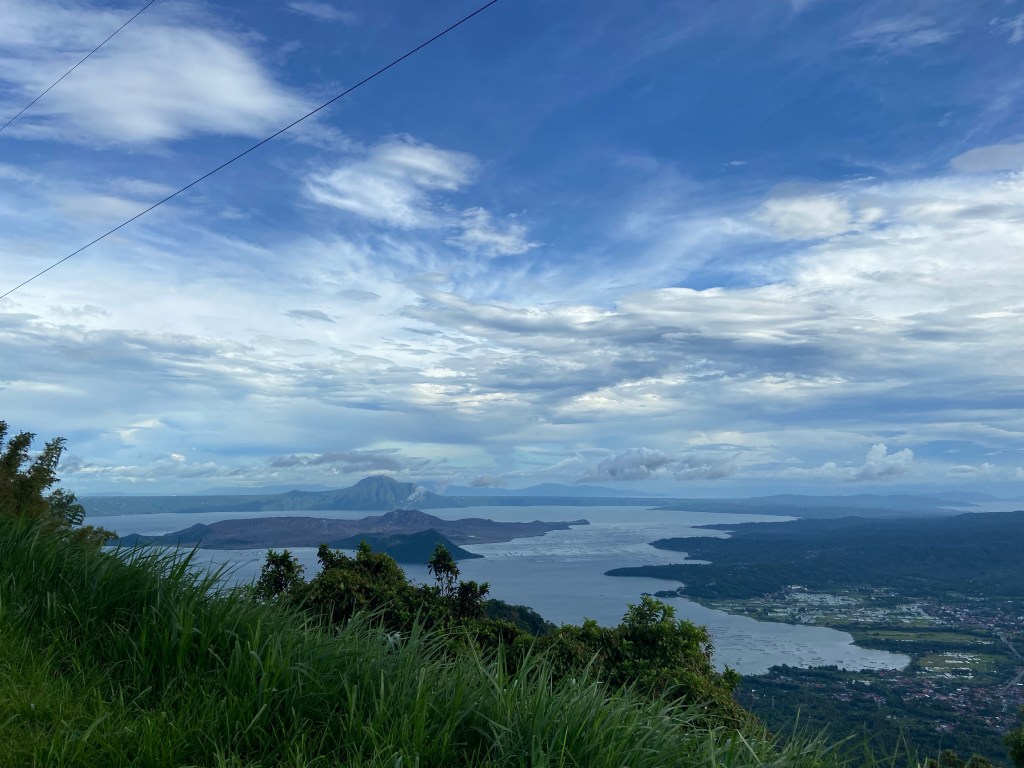
At Sky Ranch, I rode a zip line for the first time. It seemed fitting that I would ride it with my niece and nephews (my oldest cousin’s children), each of us summoning the courage to continue to climb up the stairs as the wind grew stronger. It was our shared moment, flying through the sky with the Taal volcano and lake behind us.
Dedicated to my aunt who passed away on September 26, 2022.
It was my aunt who first taught me how to iron clothes. Start with the collar, then the sleeves. The shoulders and chest next before the buttons. (Or was it the other way around?) Sweep your hand down each newly pressed section. Alternate between steam and starch until the creases are crisp, clean, undoubtedly neat.
Everyone in the family knows she was the best at ironing. It was a skill only she was able to master. As I child I never wondered how she became an expert. I assumed she simply enjoyed it. But as stories emerge at her wake about the piles of laundry she washed by hand, all generated by four younger brothers, and the meticulousness with which she washed and hung their clothes, I realized (belatedly, much to my shame) that her skill emerged out of traditional gender roles, not necessarily out of enjoyment or choice. Perhaps she did not mind doing it because it was the way she knew how to express affection for her family. My discomfort at hearing these stories again (and some for the first time) must stem from me imposing my American feminist perspective on someone who would most likely claim neither of those identities.
As I write her eulogy, I scratch out whole sections of text about her being at peace, about her sacrifices. Because I want her to be more than those things. More than the stories of how she couldn’t finish school because she had to take care of her siblings, how she never married and instead dedicated her life to family. I want her to be more than her smile and laughter, more than her pale, pretty face. I want to believe that she had secrets she whispered only to a select few. That she had depths she did not willingly show to everyone—only if she thought you deserved to know.
I can’t seem to write an ending for your eulogy. I don’t want it to be an echo of what has already been said. I want it to be true, even if it’s not as neat and comforting as the creases on a newly-ironed shirt. So I confess to those present that I do not know much about you after all. I asked questions about your life too late.
I’ve forgotten minute details: you ate a banana every day without fail; after you retired, you walked around the neighborhood daily as long as it wasn’t too cold. I was only a witness to a small part of your life. I wish I was reading your words about your own life up here. Tell me how you want to be remembered.
Pardon the delay, blog. I was busy researching and writing that major paper required for graduation.
Speaking of, you can actually download and read my paper, “Looking for Our Own Stories: Asian American Representation and the Legacy of East West Players and Theater Mu,” on the MD SOAR website (Maryland Shared Open Access Repository). The presentation of my paper is also available to view. It’s worth reading the paper and watching the presentation as they reinforce one another without repeating too much of each other. (I suggest watching the presentation first.) Here’s a little snippet from my paper:
Asian American theatres have been nurturing Asian American artists and telling Asian American stories since 1965. Theatres such as East West Players in Los Angeles; Asian American Theater Company in San Francisco; Pan Asian Repertory Theatre, National Asian American Theatre Company, and Ma-Yi Theater Company in New York City; Northwest Asian American Theater in Seattle; and Theater Mu in Minneapolis were born out of a need for Asian Americans to be seen as complex humans, to tell their own stories, and to carve out space in a field that excluded them or relegated them to minor, often stereotypical, racist roles. As Ralph Peña, the Artistic Director of Ma-Yi Theater Company states, the work of Asian American theatres is to “tell Asian stories from Asian artists, with Asian agency and centering Asian lives, therefore humanizing Asian lives….so when we do that, it’s harder to choke somebody on the subway until they’re unconscious” (Tran).
This paper focuses on two Asian American theatres that were founded nearly thirty years apart in vastly different places in the US: East West Players in 1965 and Theater Mu in 1992. This paper draws attention to theatres that have an extensive legacy of serving their communities and producing relevant programming, explores common factors that have led to each theatre’s stability and success, and interprets history through the lens of arts administration. As Asian American theatres, East West Players and Theater Mu are critical sites for negotiating identity and the evolving definition of (what it means to be) “Asian American,” and their longevity has been powered by the resilience of Asian American artists and a vital commitment to representing their communities.
I was going to write a reflection on the research and writing process, but it’s been almost 4 months since I submitted the paper. And frankly, how much do I really remember? (And maybe, that process and reflection should just be for me.)
And yet. I want to document it here as well. Document its existence. Document my words and the words and experiences of the people I interviewed for the paper. Document and share the news that my paper was one of two papers selected as the winners of the Jean Wilhelm Award for best paper!
Is this the time for a mic drop? And champagne? Yes to both!
Since I’m on a documenting spree, might as well drop this here. I was the graduate student speaker at Commencement in May. My speech starts at around 31:35.
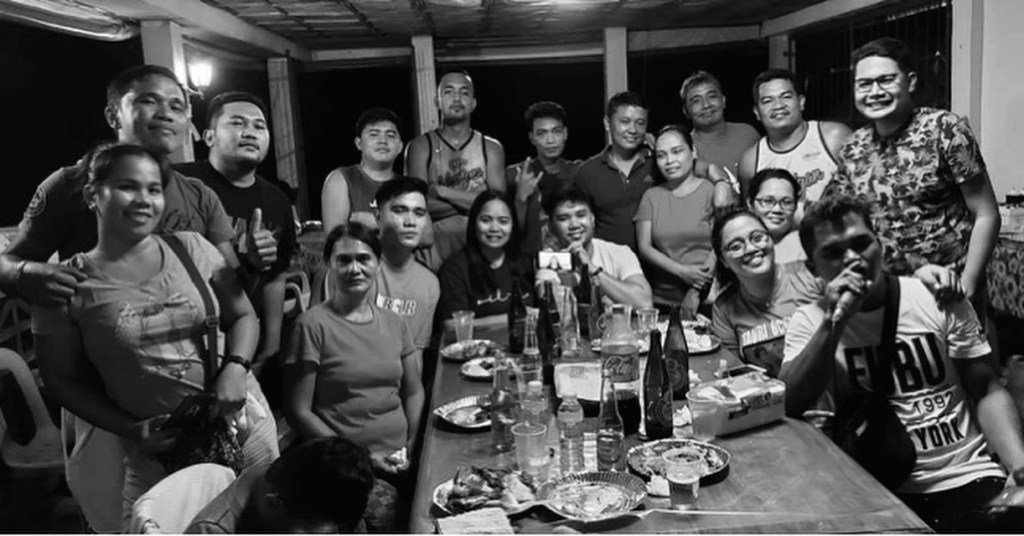
My cousins in the Philippines sent photos of their mini gathering a few weeks ago and it made me miss them and being around family so much. That, along with friends celebrating Lunar New Year with their inherited and chosen families, inspired this free write:
At this kitchen table

This kitchen table is the beginning
and never the end.
New friends are welcomed here.
Old friends have cried here.
We yell and laugh here,
at this kitchen table.

This kitchen table
has endured coffee spills
and knife cuts.
It has heard its share of tsismis.
It holds the weight of a family bickering
about money, careers, bad behavior.

Holiday meals have been served here.
Ordinary meals, party buffets,
merienda prepared by grandparents,
the occasional snacks and beer.

Stories have been exchanged here.
Stories are being written here.
Lives are being lived here,
at this kitchen table.
Yesterday I found out that a family friend passed away this week. Somehow to say “family friend” doesn’t suffice. She was my mom’s first friend in the US. They met at Super Fresh, a grocery store within walking distance of our two bedroom apartment. The six of us lived there for a few years: my parents, my older sister, my aunt (dad’s older sister), my grandmother, and me.
Never the one to sit around all day, my mom went out on her own and walked to the grocery store and inquired about a job. Ms. Peggy was one of the first to befriend her. To this day when I hear my mom say over the phone, “Hello, my friend!” I know she can only be talking to one of two people: Ms. Peggy or Ms. Prasak, also one of my mom’s first friends.
Ms. Prasak lived a few doors down from us and was one of the few Asian faces—and people of color—in our neighborhood. The other Asian family was from Korea; they too, had two daughters. It was in that neighborhood where I first learned about and faced racism. Eggs were thrown against our front door. One Halloween season, pumpkins were smashed on the street, but only that of the families of color. One afternoon, when my grandmother was sitting outside enjoying the fresh air, white men in a truck drove by and yelled several racial slurs at her. They vowed they wouldn’t move into the neighborhood.
When we moved to a house of our own a few years later, Ms. Peggy and her husband were one of the people who helped us move into our new house. We moved at night, a few days before the new year. As their friendship grew, my sister and I would also spend time with Ms. Peggy’s family. I remember playing with the other kids, going to parties, and Mom cooking and sharing Filipino food. Pancit was a particular favorite. As my sister and I got older, we lost touch, but Mom always remembered Ms. Peggy at Christmas, or whenever she cooked pancit. They reunited several years ago—my mom and her friend.
***
Lately I’ve been thinking a lot about friendship. About what it means to be a friend, how friendships evolve, how some come to a natural end, how a few start quickly and dissipate as quickly, how some do stand the test of time. I’ve realized that there’s no magic formula to a long-lasting friendship. You’ll invest in people, be vulnerable with them, laugh with them and in a month you might realize they’re really not your people after all. I usually build walls then.
I’ve also realized that the ones that have lasted for a while—my deepest, strongest relationships—are also the “easiest.” We don’t expect to be around each other all the time. We don’t even text that often. But when we are together, we are together. I am learning that not every friendship has to be like that either.
***
From what I’ve observed and from what I remember, my mom’s friendship with Ms. Peggy was like that. Despite the time and distance, they never forgot what brought them together. Ms. Peggy was one of our first meaningful connections in a country that was both foreign and familiar. She was open, generous, and kind. She came into our lives—and we became a part of hers—at a time of major transition.
When I hear my mom say “my friend,” I can hear the weight of that word. I’ve deemed you as someone who is important to me, as someone who is worthy of my love and affection. I’ve chosen you, and you’ve chosen me. Hello, my friend.
It’s odd to call myself a playwright, let alone a lyricist even though I have been working on an original musical for almost two years now. I didn’t set out to be one, and to be honest, I’m not sure if I want to be one.
I look at Asian and Asian American playwrights I know or have read and I could never be on par with them. And that’s ok! There are plenty of writers, poets, and performers who are better than me. Poets and writers who have an extensive vocabulary, a way with imagery and metaphor I can’t replicate, and a discipline and persistence I’m trying to find for myself. Despite all that, I remind myself every day that I still have something to say and only I can say it in my style.
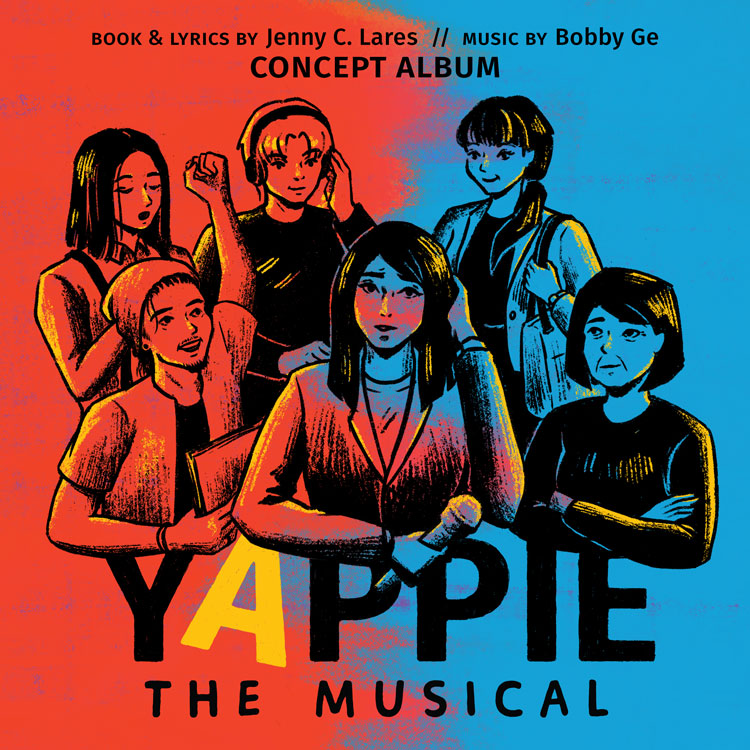
So when I joined the Yappie the Musical project back in July 2019, I was nervous and excited. I also felt a sense of freedom because I didn’t know any of the rules about theatre and musicals and songwriting so I wasn’t bound to them. One of the most emotionally draining lessons was learning about syllabification. I smile at the memory of that moment now.
I finished the lyrics to the tracks of our concept album months ago. I usually don’t have such a long period between “finishing” a piece and sharing it with the world on the blog, on social media, or in a performance (except for when I’m working on a chapbook). So I feel somewhat distanced from these songs. Did I really write them?
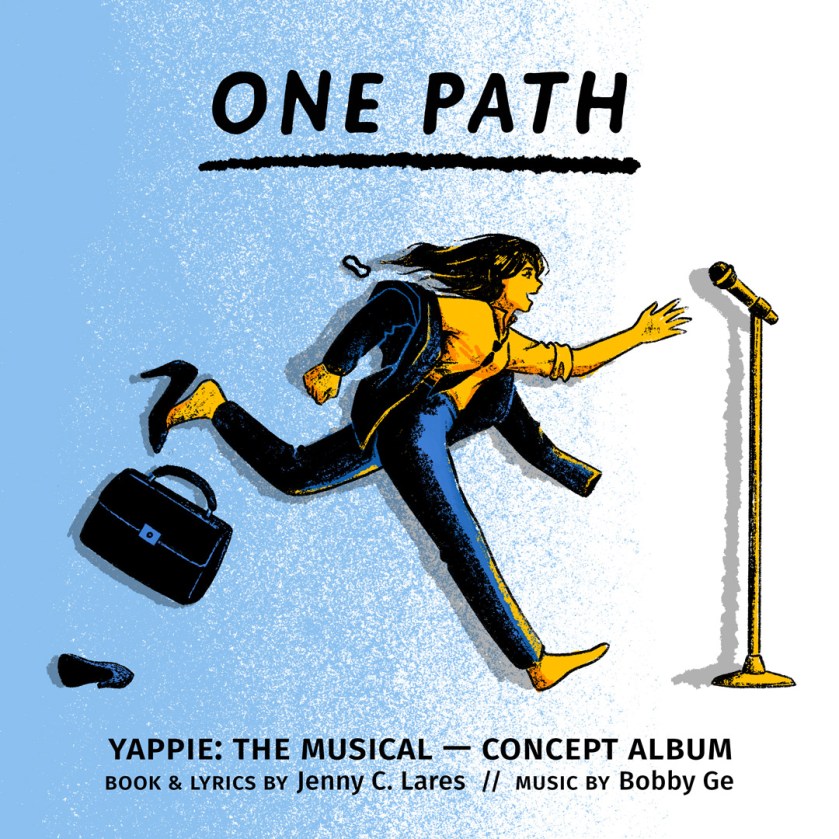
I try to remember what the process was like writing the lyrics. Sometimes it took 2 hours just to write one line. One line! When I felt an inkling of a line forming but it was still an amorphous blob, I learned to surrender to it, to not think too hard, and the words appeared. It was like that with part of the second verse of our single track, “One Path.” I was trying so hard to find a word that rhymed with “design.” Armed with my rhyming dictionary gifted to me by my sister when I was still in high school and several rhyme websites, I could sense I was close and the moment I let my guard down, the rest came to me, as they say. Because of that, these four lines are my favorite part of the song.
What if I try to go off-script?
A blank sheet with no design
How can you tell if you succeed
Without a course, a trail outlined
Throughout this process I’ve asked myself if writing songs is easier than writing poetry. (To be clear, I think lyrics are poems, too.) I think poems are harder to write because you can’t hide behind the music and you can’t waste words. I love so many songs more for the music than the lyrics, which may seem odd as a writer, but it’s true! My musical collaborator, the brilliant composer, Bobby Ge, and I have had several conversations about how some lyrics on their own don’t make any sense. But they sound good with the music. Some are super catchy and it sparks an internal battle of “The beat is so good but the lyrics are wack. Can I still love you?”
You may feel the same way too once you hear the rest of the concept album. And you know, that’s cool. I don’t mind. I did the best I could in that moment. I’m proud of the work we’ve done and how we managed to pivot the project. I’m grateful to the creative team, the vocalists and musicians, the sound engineers, graphic designer, and video editors for sharing their talents and time and for believing in the project (see here for a complete list).
At one of our last in-person meetings as a creative team, I shared with one of the producers that I wanted to record the songs. Not necessarily to share with the world (at this point we thought we’d have a workshop premiere in May and had yet to seriously think about its future), but something for us. A souvenir, another thing to add to our artist portfolios, proof that it happened.
The idea of a recording transitioned into a concept album that will be streamed, downloaded, and shared for who knows how long. It’s surreal to think of it that way. That even though the musical itself is still a work in progress–and it will be for a long time (Hamilton took 7 years? Hadestown took 10?)–a little piece of it is preserved in this moment. A testament to our creativity and adaptability in a time of global crises. To the enduring power of the arts.
The full concept album will be released on bandcamp on Friday, May 28.
Two poems poured out of me right when I was about to sleep. So here they are for anyone who needs it.
take care
mag-ingat ka

two words that usually means
drive carefully —— don’t speed
watch where you walk —— look both ways before you cross

two words uttered by mothers
whose children hurry to leave
wave away the worry once again

two words to chase away the spirits
a chant
a talisman
a prayer
that follows us home
They’re both pretty raw, but so am I.
Tell me—— How do we protect each other? Cradle each other’s life Like our own heartbeats Hold each other tight to the chest like armor How do we make space for each other? Give without reward or recognition Unwind the strings meant to strangle us
Tell me—— How do we protect our immigrant mothers and grandmothers? Their backs sacrificed for cash and 2nd generation dreams
Will they ever tell us They had a bad day at work?


 three generations